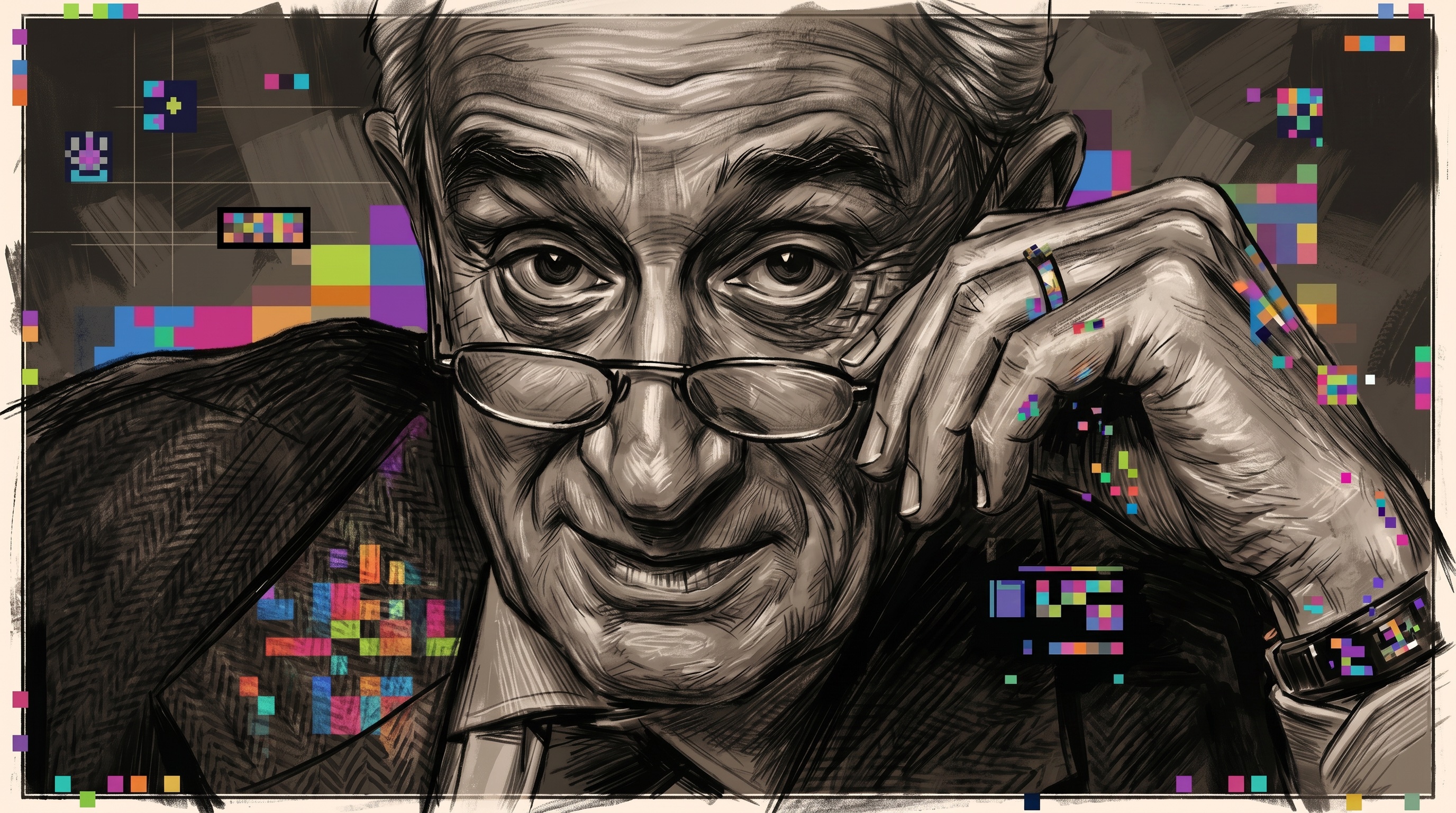
Giovanni Sartori — 1924 – 2017
Italian political scientist · Guidelines for Concept Analysis, 1984
Design – Meaning – Ambiguities
Design, a term famously fashioned for making things beautiful, is an expression for which many other usages are also applicable. The aim of this research is to cater to these meanings which are creating ambiguity and vagueness in the concept of the term design and how it is used. We are using a conceptual framework provided by Giovanni Sartori in the Guidelines for Concept Analysis — in which the author has provided some principles to clear the problems several researchers and theorists often face with respect to terms and their concepts. We have then applied these guidelines to the term 'Design' and tried to clear the uncertainties and fuzziness in the concept of it. A formal definition is proposed, encompassing characteristics taken from different definitions from various authors, practitioners and academics, in order to achieve one single definition.
When we wake up in the morning, we are surrounded by a lot of products — the phone we just used to turn the alarm off, the knob of the bathroom door. All these products we are surrounded by are designed. Even our smartphone's screen, the interaction, the interface — all product design. We are literally surrounded by Design. But what is Design?
"To make, shape," ultimately from Latin designare "mark out, point out; devise; choose, designate, appoint," from de "out" + signare "to mark," from signum "identifying mark, sign." The Italian verb disegnare in the 16c. developed the senses "to contrive, plot, intend," and "to draw, paint, embroider." French took both these senses from Italian, in different forms, and passed them on to English.
Because we all use it and are living in it. We can see countless artifacts that surround us and not only do they shape our lives but also sustain it. Design is evolving and so is our understanding of it. Donald Norman coined the term "user experience" at Apple in 1990. Now we have a whole field related to it. There are more than forty disciplines which use design, and the way they use it affects the future of the world.
The concept of design needs a clear meaning, as the meaning will drive its usage and thus affect our world. In a layman's term design is what people say about objects: "what a curvy design," or someone appreciating a pattern of lines. But there are also various other disciplines — software design, social design, experience design — where design means something entirely different. The term has more objects and referents than any single definition can hold. I am borrowing the process of Giovanni Sartori from his Guidelines for Concept Analysis to resolve this problem.
Design has been taken as a serious study of research in literature. Consider the following definitions provided by design authorities, practitioners and academics:
By analyzing these definitions, different concepts linked with the word can be obtained: design as a process, design as a creation, design as planning, design as physical activity, design as goal or purpose, design as collection of activities, design as an artifact. The usage of the term design has also affected its definitions. With respect to geographical usage: Denmark sees design as "a process dealing with uniting technology, marketing, sales, recycling and disposal." Sweden sees it as "the planned and innovative use of available knowledge." Norway sees it as "thinking and planning in order to give shape to things." The word carries different weight in different hands.
Giovanni Sartori was an Italian political scientist who specialized in the study of democracy and comparative politics. His notion of "conceptual travelling" and "conceptual stretching" is unparalleled in social science methodology.
Language is a complex phenomenon. Formal language has univocal characteristics — a single clear meaning. But we don't communicate in formal language, so most words we use are equivocals: words with more than one meaning, which create misunderstanding in both general communication and research work. As Sartori says, "bad language generates bad thinking and bad thinking creates confusion."
The Sartorian conceptual framework holds that clear thinking requires clear language and language requires precise definitions. Terms can be broken down into: (1) words (terms), (2) meanings (connotations / intension), and (3) referents (denotations / extension).
Confusions and ambiguity happen because of problems in the term — either because we have associated more than one meaning with it, or we have defective meaning-to-referent relations. The first is a terminological problem; the latter, denotational. For design we will analyze both and attempt to cure the problem using Sartori's rules.
When someone says "we design chairs" — the term design is used as a process: the creation of the chair is an activity performed to achieve an empirical goal. But if someone says "we design strategy" — the user plans, which is an intangible product in the mind, not empirical in nature. When someone says "look at the designs" the connotation is creative in nature. In all these cases the term design is single but has more than one connotation: creation, planning, mental activity, physical activity, creativity.
Sartori calls for reconstruction of definition: "In reconstructing a concept, first collect a representative set of definitions; second, extract their characteristics; and third, construct matrixes that organize such characteristics meaningfully."
From a collected body of definitions, certain characteristics of design have been extracted:
Design is created by element(s) applied by a performer (mostly human) — is object oriented, executed in a constraint environment, to produce aesthetically appealing (if applicable), constructive goals.
This definition has the discriminative power of a concept, applicable across more than forty-five disciplines, encompassing both the rational model — where designers optimize a design candidate for known constraints through a plan-driven sequence — and the action-centric model, where creativity and emotion generate design candidates in a non-universal, improvised process.
Both models carry the characteristics present in the proposed definition: constraints, plan, process, creativity — with additional properties of environment, aesthetics, and the generator (mostly human). This definition can serve formal research, educational, and professional needs.
Design, having a vast field of disciplines applied to it, called for a definition where we can converge on "how to define the term design."
The proposed definition collectively encompasses the characteristics and at the same time substantiates the requirements of the referent being applied to and the disciplines as they stand today. A clear understanding of design helps teaching institutions where the basics of teaching is the word design. In many places, professions are even built on the term — where the building block that is the concept still lies unclear.
Clear perceptions create purposeful longevity and future. This is not just a philosophical exercise. The concept of design is what makes design, which is present in the philosophies of all the disciplines which are built on and dependent on it. And if we cannot agree on what it is, we cannot agree on what we are making — or what we are making it for.